Skin Cancer Centre

Specialist Skin Cancer Surgery & Reconstruction

Consultant Plastic and Reconstructive Surgeon specialising in skin oncology within the NHS and privately. Works in one of the UK's busiest skin cancer units in the UK. Royal Marsden fellowship trained. Attends both Specialist and Local Skin Cancer Multi-Disciplinary Team (MDT) meetings weekly.

Book a Consultation Book a Mole Check
2 Weekly MDT Meetings
PI EORTC Mini-Tub Trial
Advanced Skin Cancer Management
Member Melanoma Focus UK
Concerned about a mole or skin lesion?

We aim to see patients with urgent skin concerns as soon as possible. A new, changing or non-healing lesion should never be ignored — early assessment means earlier diagnosis and significantly better outcomes.

Skin Cancer in the UK

A Rising Challenge, Highly Treatable When Caught Early

Skin cancer is one of the most common cancers in the UK, and rates are continuing to rise. More than 150,000 non-melanoma skin cancers are diagnosed every year in the UK, and melanoma is now the fifth most common cancer overall. The good news is that when identified early, skin cancer is highly treatable — with excellent long-term outcomes and, in the majority of cases, complete cure following surgery.

Mr Masha Singh has dedicated his career to this field. Following core plastic surgery training, he completed his higher surgical training in London. He undertook a dedicated fellowship at The Royal Marsden Hospital — Europe's largest specialist cancer hospital. He is trained in the full spectrum of skin cancer surgery, from complex melanoma management and sentinel lymph node biopsy through to reconstruction of the most challenging defects of the face, scalp and limbs.

Today, as a Consultant Plastic Surgeon, he attends and regularly leads the Specialist Skin Cancer MDT at St George's Hospital — one of the UK's busiest skin cancer units and the hospital that pioneered sentinel lymph node biopsy for melanoma in the UK. He also provides specialist input to the local skin cancer MDT at Croydon University Hospital and attends the PRD (Plastic Surgery, Radiotherapy and Dermatology) clinic, a multidisciplinary clinic run jointly with Dermatology and Oncology with specialist skin cancer nursing support. Patients benefit from this depth of NHS experience in every consultation, NHS and private alike.

Understanding Skin Cancer

Types of Skin Cancer

The three most common skin cancers behave very differently — and each has its own treatment pathway. Understanding which type you or a loved one is facing is the first step towards the right care.

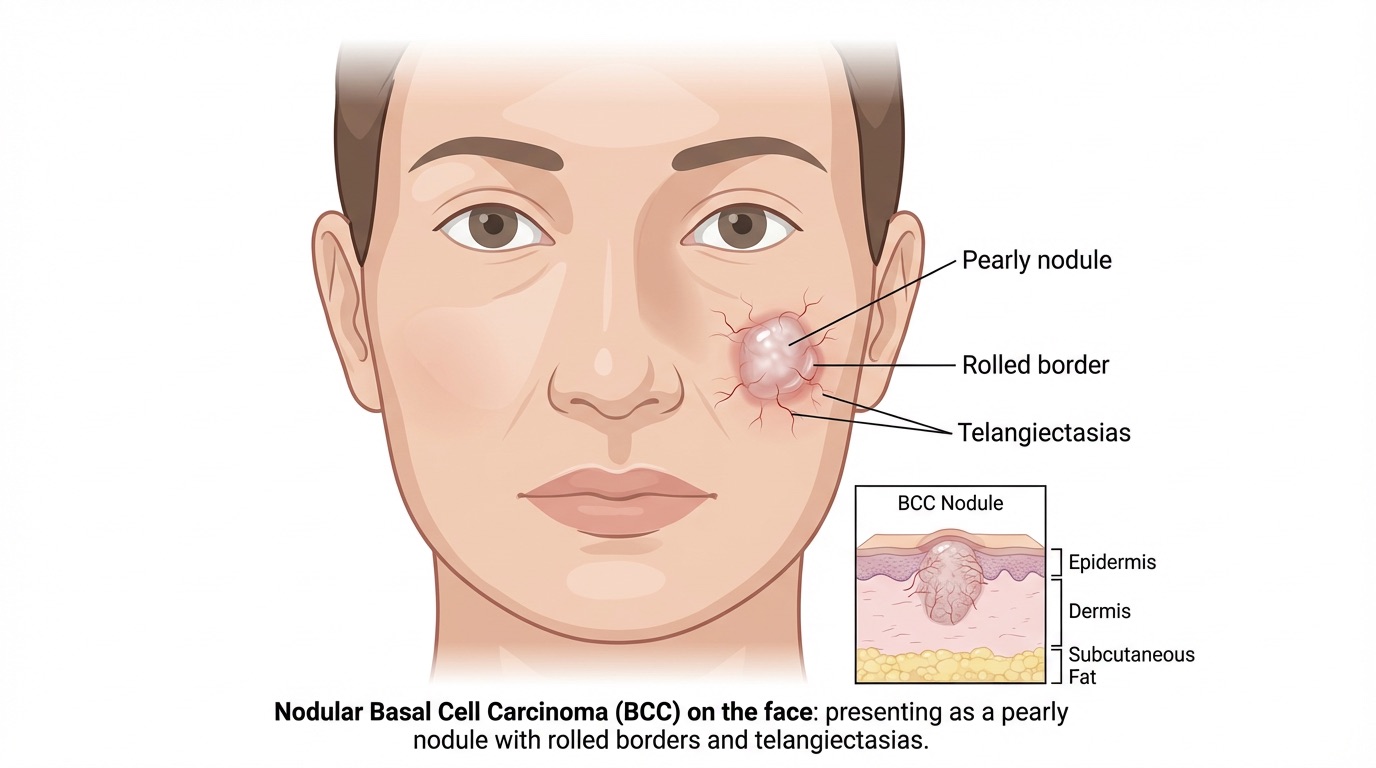
Illustration of a nodular basal cell carcinoma on the face
BCC

Basal Cell Carcinoma

The most common skin cancer. Slow-growing, very rarely spreads, but can cause significant local damage if left untreated. BCCs typically appear as a pearly bump, a non-healing sore that repeatedly scabs and bleeds, or a flat scaly patch — most often on the face, scalp, neck or back.

Most Common UK Skin Cancer
Excellent Surgical Outcomes
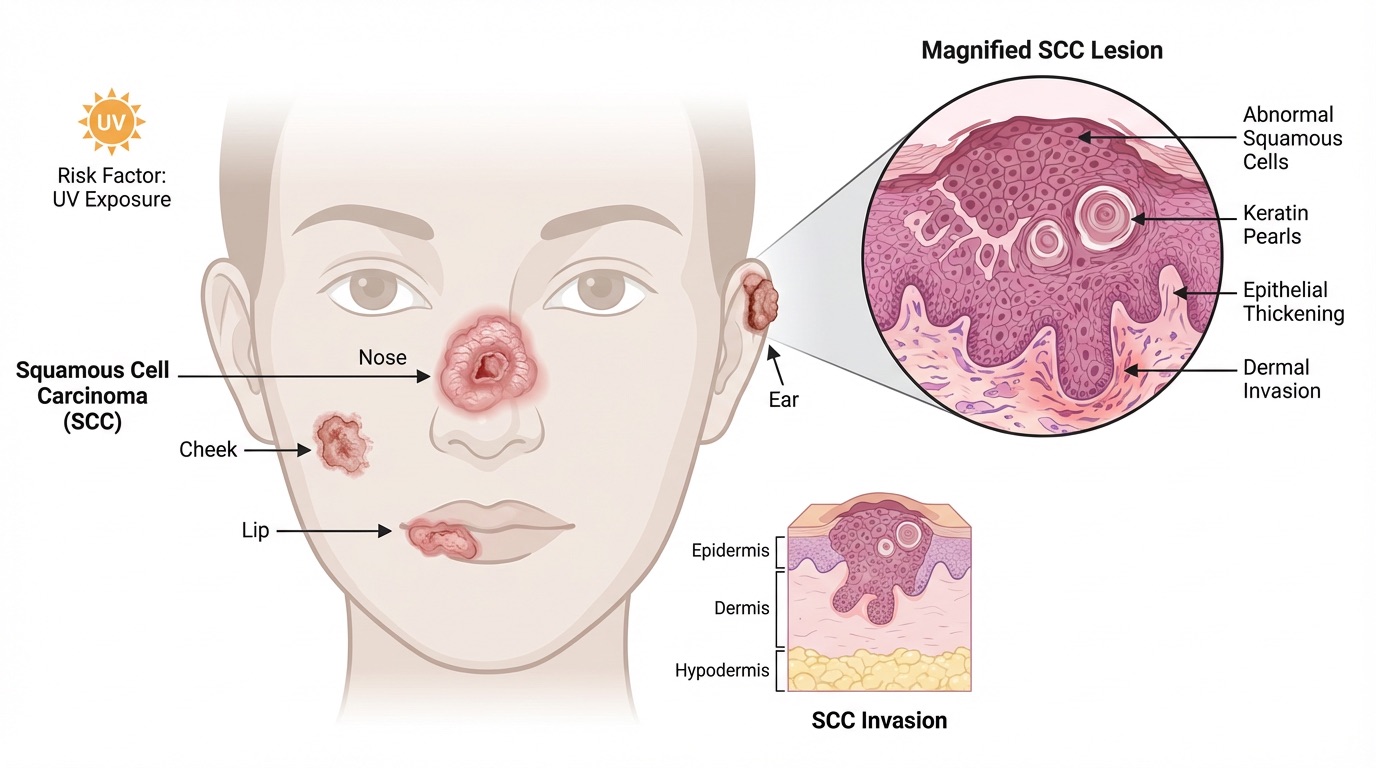
Illustration of a squamous cell carcinoma on the face
SCC

Squamous Cell Carcinoma

The second most common skin cancer. Typically arises from chronically sun-damaged skin and, unlike BCC, can spread to lymph nodes and beyond if neglected. SCCs may appear as a scaly red patch, an open sore that won't heal, or a wart-like or crusted growth — most often on the head, neck, backs of the hands and forearms.

Faster-Growing Than BCC
Treatable When Caught Early
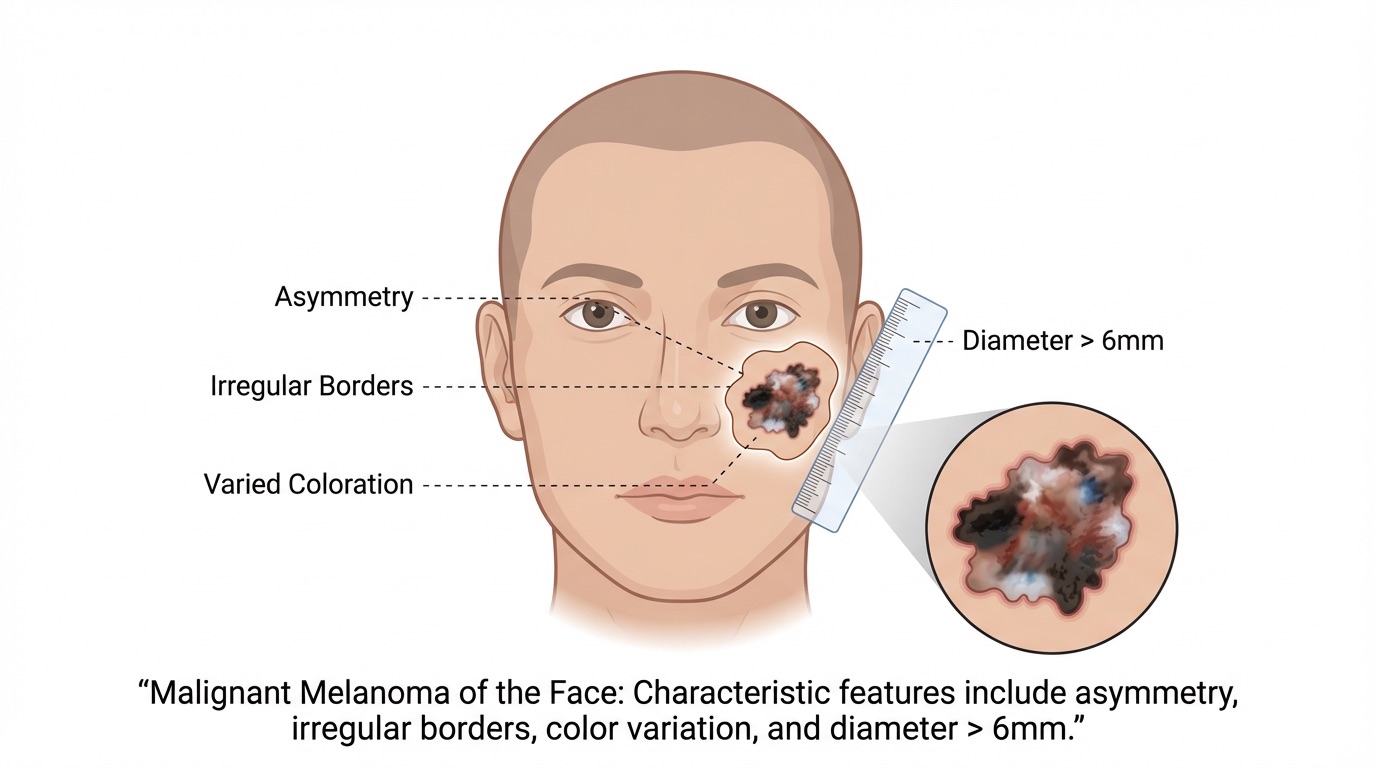
Illustration of a malignant melanoma on the face
MM

Melanoma

The most serious form of skin cancer, arising from melanocytes — the pigment-producing cells of the skin. Melanoma can develop within an existing mole or appear as an entirely new pigmented lesion. Early detection is critical: when identified at an early stage, 5-year survival exceeds 95%, which is why knowing the signs and seeking prompt review matters.

Early Detection Absolutely Critical
>95% Survival When Early
Your Pathway of Care

From First Concern to Long-Term Follow-Up

Every patient follows a clear, consultant-led pathway. You will always know where you are in the process and what happens next.

1

Initial Enquiry

Get in touch about any skin concern, self-noticed lesion or GP referral. Our team will triage urgent cases for the earliest available slot.

2

Consultation & Dermoscopy

A full clinical examination of the lesion of concern, with dermoscopy to assess pigment patterns, vascular structures and other features invisible to the naked eye.

3

Biopsy if Required

When a lesion is suspicious, a small tissue sample (or complete excisional biopsy) is taken under local anaesthetic to confirm the diagnosis and guide treatment.

4

MDT Discussion

If cancer is confirmed, your case may need to be discussed at a Skin Cancer MDT. Mr Singh will guide you through the process for this.

5

Treatment Plan

A personalised plan is agreed with you — whether surgery with reconstruction, Mohs referral, radiotherapy, topical therapy or electrochemotherapy — always tailored to you.

6

Surveillance

Structured long-term follow-up at intervals guided by UK national guidelines, with ongoing education and support to help you protect your skin for life.

Team-Based Expertise

Our Multidisciplinary Approach

Modern skin cancer care is never a one-person decision. Every complex case benefits from the combined expertise of multiple specialists — and Mr Singh works at the heart of three skin cancer multidisciplinary teams.

Mr Singh leads or attends the Specialist Skin Cancer MDT at St George's Hospital (weekly), the Local Skin Cancer MDT at Croydon University Hospital (weekly), and the PRD Clinic — a combined multidisciplinary clinic run jointly with Dermatology and Oncology for patients whose management requires the input of the whole team in one room. Every patient he treats privately has the reassurance that the same rigour and collective expertise informs their care.

Dermatologists Consultant-level diagnostic expertise in skin lesion assessment, dermoscopy and medical management — often your first referrer and a key partner in shared-care follow-up.
Clinical & Medical Oncologists Specialist input on radiotherapy, immunotherapy and targeted systemic treatments for advanced or high-risk skin cancers, especially melanoma and aggressive SCC.
Pathologists & Radiologists Detailed histopathological review of every biopsy and imaging interpretation (ultrasound, CT, MRI, PET-CT) to stage disease accurately and plan surgery with precision.
Clinical Nurse Specialists Dedicated cancer nurse specialists who provide continuity, advocacy and practical support from diagnosis through treatment and into long-term follow-up.
The Full Range of Options

Treatment Options

Skin cancer is not a one-size-fits-all diagnosis. Mr Singh counsels every patient on the full range of treatment options — balancing oncological safety, functional outcome, cosmetic result and your personal preferences.

Surgery

Wide local excision with primary closure, local flap repair or skin grafting — the gold-standard treatment for most BCCs, SCCs and melanomas, performed under local or general anaesthetic depending on size and site.

Mohs Micrographic Surgery

For cosmetically sensitive or recurrent BCCs and SCCs on the face, Mr Singh refers to specialist Mohs surgeons for tumour removal and then performs the reconstruction himself — combining oncological clearance with consultant-led plastic surgical repair.

Radiotherapy

A non-surgical option appropriate for selected patients — for example those medically unfit for surgery, or where surgical excision would cause major functional loss. Discussed as part of the MDT and the PRD clinic.

Topical Treatments

Imiquimod, 5-fluorouracil (5-FU) and similar creams can be used for selected superficial BCCs, in-situ SCC (Bowen's disease) and widespread actinic damage — avoiding surgery in appropriate cases.

Electrochemotherapy (ECT)

A specialised treatment combining localised electrical pulses with chemotherapy agents, offered at St George's to patients who are unsuitable for surgery — particularly useful for recurrent, multiple or large cutaneous metastases.

Reconstructive Surgery

The true plastic surgical specialism — restoring form and function after cancer removal using the full reconstructive ladder, from primary closure and skin grafts to local, regional and free tissue transfer for complex defects.

Know the Signs

The ABCDE Rule for Moles

One of the most useful tools for spotting an early melanoma at home is the ABCDE rule, which highlights five features of a mole that may warrant specialist review: Asymmetry, Border, Colour, Diameter and Evolution. Any single feature can be enough to justify a check — and if you are unsure, it is always worth asking.

Our full guide walks through each letter with clear patient-facing examples and explains what to do if you notice any of these changes in your own skin.

Read the Full ABCDE Guide
Common Questions

Skin Cancer Care FAQs

A few of the questions we are asked most often. If your question isn't answered below, please do get in touch.

No. You are welcome to self-refer and book a consultation directly. If you already have a GP or dermatologist letter, please do bring it as it helps us prepare, but it is not a requirement. Some private medical insurers do ask for a GP referral before authorising cover — our team can advise on your specific policy.

The UK's major private medical insurers — including Bupa, AXA Health, Aviva, Vitality, WPA and Cigna — cover skin cancer diagnosis, biopsy, surgical excision and reconstruction. Mr Singh is recognised by each of these providers. We recommend calling your insurer with the consultation and procedure codes we provide to confirm your cover before each step of treatment.

We prioritise urgent skin cancer concerns and aim to see patients as soon as possible. If a biopsy is needed, this will be discussed during the consultation. Results are typically available within one to three weeks, after which you will be reviewed again to discuss next steps.

Mr Singh will fully discuss and explain the results to you. If MDT discussion is required, the process for this will be outlined. Mr Singh will then go through the recommended treatment and the options available to you. The great majority of skin cancers are successfully treated with a planned surgical excision under local anaesthetic.

Sentinel lymph node biopsy is a specialist procedure that Mr Singh can discuss with you in full detail at consultation. It is offered within the NHS pathway at St George's Hospital, which pioneered the technique in the UK. Mr Singh does not currently offer SLNB privately but can arrange specialist onward referral when appropriate.

Take the Next Step

Take the Next Step

Whether you have a specific lesion of concern, a family history of melanoma or simply want the reassurance of a specialist skin check, we are here to help. Book a consultation today and take the first step towards clear answers and specialist care.

Book a Consultation