Earlobe Repair
Earlobe repair is a quick, minimally invasive procedure to reconstruct earlobes that have become split, torn or stretched through trauma, heavy earrings or gauges. It is an ideal solution for patients wishing to restore a smooth, natural earlobe shape and, in many cases, wear conventional earrings again.
Overview
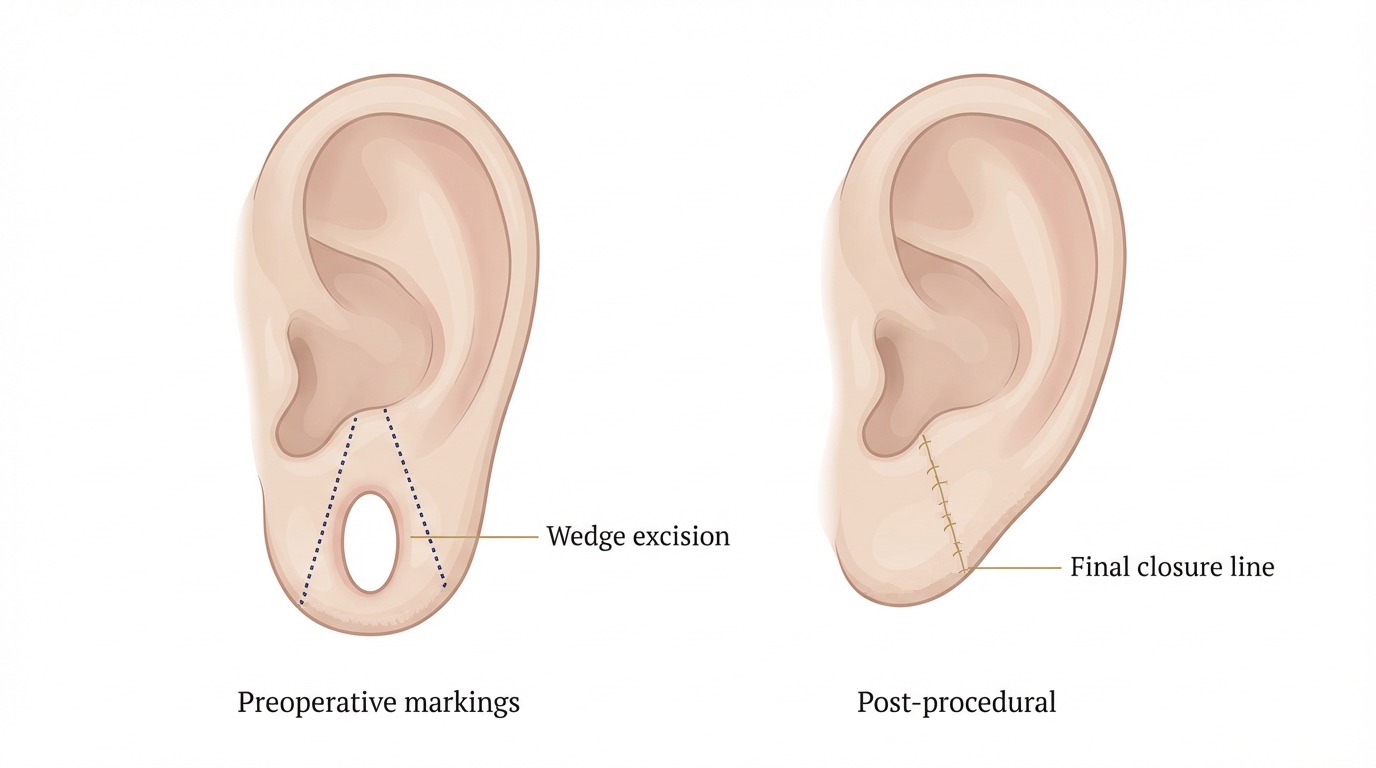
Earlobe repair is a surgical procedure that reconstructs earlobes which have been split, torn or stretched. The most common reasons patients seek repair are a gradual stretching of the ear piercing under the weight of heavy earrings, a sudden tear caused by an earring being caught or pulled, or the deliberate stretching of the ear with flesh tunnels or gauges which has since been reversed.
The procedure is carried out under local anaesthetic as a simple day case and takes around 30–45 minutes for both ears. Mr Singh carefully freshens the edges of the tear or stretched opening and reconstructs the earlobe using fine plastic surgical technique to leave the smallest, most discreet scar possible.
Benefits
- Restored earlobe shape: A smooth, intact earlobe is recreated from a torn, split or enlarged piercing.
- Ability to wear earrings again: Once fully healed, the earlobe can usually be re-pierced, allowing you to wear earrings with confidence.
- Reversal of gauge stretching: Previously gauged earlobes with large open tunnels can be returned to a natural, closed appearance.
- Quick and minimally invasive: Performed under local anaesthetic with minimal downtime and a same-day return home.
- Discreet scarring: Careful plastic surgical closure produces a fine, inconspicuous scar along the earlobe.
- Improved self-confidence: Patients often feel more comfortable wearing their hair back or in styles that previously drew attention to the earlobe.
Surgical Techniques
The exact technique is tailored to the pattern and extent of the damage. Mr Singh will examine the earlobe in detail and explain the most suitable approach during your consultation. The procedure is performed under local anaesthetic as a day case.
- Local anaesthetic: The earlobe is numbed with local anaesthetic so that the procedure is comfortable throughout.
- Edge refreshment: The existing skin edges of the tear or stretched hole are trimmed to remove scarred, epithelialised tissue and create fresh surfaces that can heal together.
- Straight-line or z-plasty closure: A straight-line repair is used for simple splits, while a small z-plasty or v-y closure may be used to avoid notching at the earlobe margin.
- Layered closure: The earlobe is closed in layers with fine absorbable sutures deep and very fine sutures on the skin for an optimal final scar.
- Gauge reconstruction: For previously gauged earlobes, excess stretched skin is excised and the earlobe is reshaped into a natural contour before closure.
- Re-piercing: Once fully healed, the earlobe can usually be safely re-pierced, typically at least 3 months after surgery and in a position slightly away from the repair line.
Risks & Considerations
General Risks
- Infection: A small risk of wound infection which can delay healing and may require antibiotics.
- Bleeding and bruising: Minor bleeding or bruising around the earlobe is common and settles within 1–2 weeks.
- Scarring: All surgery leaves a permanent scar. The aim is for this to be as fine and discreet as possible, but scars cannot be eliminated entirely.
- Local anaesthetic reaction: Very rare allergic or systemic reactions to local anaesthetic.
Specific Risks to Earlobe Repair
- Notching: A small step or notch along the lower margin of the earlobe can occasionally develop if healing is uneven.
- Asymmetry: Minor differences in size and shape between the two earlobes can persist or become more noticeable after repair.
- Hypertrophic or keloid scarring: Earlobes are a relatively common site for thickened or raised scars, particularly in patients with a history of keloids.
- Re-tearing: A repaired earlobe is always slightly weaker than a normal one, and wearing heavy earrings again can cause the repair to stretch or tear.
- Numbness: Temporary altered sensation around the earlobe is common and usually resolves within a few weeks.
- Dissatisfaction with final scar: Very rarely, scar revision may be considered if the scar has not matured favourably.
Recovery
Immediate Aftercare
- Pain control: Discomfort is usually very mild and well controlled with simple analgesia such as paracetamol.
- Swelling: Minor swelling and bruising around the earlobe is normal and usually settles within 7–10 days.
Wound Care
- Dressings: A small dressing is applied and can usually be removed within 24 hours. Gentle cleaning with mild soap and water is then encouraged.
- Suture removal: Fine skin sutures are usually removed at 10–14 days; deeper stitches are dissolving.
- Avoiding earrings: No earrings should be worn for at least 3 months to allow the repair to heal fully before re-piercing.
- Avoiding traction: Take care not to catch the earlobes on hairbrushes, towels or clothing during the early healing phase.
Scar Advice
- Silicone gels: Silicone gels or sheets can be applied once the wounds are healed to help optimise the final scar.
- Sun protection: Protect the scars from sun exposure for the first 6–8 weeks to prevent pigmentation changes.
- Scar massage: Once fully healed, gentle scar massage helps the scars soften and flatten over time.
Follow-Up
- Initial post-op visit: Typically scheduled 10–14 days after surgery for a wound check and to remove any non-absorbable sutures.
- Subsequent visits: Usually seen again at 6 weeks and again at around 3 months to review the scar and discuss re-piercing if desired.
- Long-term care: Mr Singh remains available for any concerns or further follow-up as required.
Procedure Summary
Ready to Discuss Earlobe Repair?
If you are considering earlobe repair, please feel free to contact us to answer any questions you may have or to schedule a consultation and learn more about how this procedure may benefit you.
Book a Consultation